
Does Multitasking Make You Less Productive?
What neuroscience and psychology tell us about getting things done

In a world of constant notifications, open tabs and buzzing phones, multitasking can feel less like a choice and more like an essential skill.
But does juggling several tasks at once actually help us get more done? Scientific research suggests not. When we take on tasks simultaneously, we tend to do them more slowly and to a worse standard than if we tackled them one at a time.
Think you might be an exception? According to one survey, a statistically improbable 93% of people believe they’re better-than-average multitaskers! But consider this: the better you think you are, the worse you’re likely to be at it.
So what’s really going on when we try to split our attention? And what can science teach us about getting things done in a more productive – and healthier – way?
Find out by giving yourself five minutes to focus on the latest iluli explainer video. Then read on for highlights from the key research and some practical tips to break free from the multitasking myth.
The origin of the myth
IBM coined the word “multitasking” in the 1960s to describe a computer performing two operations simultaneously. But these early computers weren’t actually capable of parallel processing. They were rapidly switching tasks to give the illusion that they were.
Decades later, with the development of dual-core and multi-core processors, a single chip can now execute multiple operations at once. Humans, of course, have not had a hardware upgrade. Yet we’ve adopted the term – and the unhelpful expectation – anyway.
The brain’s bottleneck
When neuroscientists examined what happens in the brain when we try to multitask, they arrived at a striking conclusion. According to Stanford University researchers Kevin Madore and Anthony Wagner:
“The human mind and brain lack the architecture to perform two or more tasks simultaneously.”
Functional MRI scans have shed more light on why this might be the case. In the brain’s information-processing region, a bottleneck occurs which prevents us from making two decisions at once. A team of psychologists and neuroscientists at Vanderbilt University found that, when we attempt to multitask, “the execution of the first task usually leads to postponement of the second one.”
Brain imaging research also supports the theory that our capacity for attention is finite. When we start an activity, blood flow increases to the area of the brain relevant to that task. But this comes at the expense of blood flow to other regions. As Professor Suzana Herculano-Houzel explains, our “inability to do two things at the same time might have its origins in blood flow to the brain being supply-limited, not demand-based.”
All of this suggests that, like the early computers, we’re not really multitasking; we’re rapidly flipping our attention between one task and another.
The cognitive costs of task switching
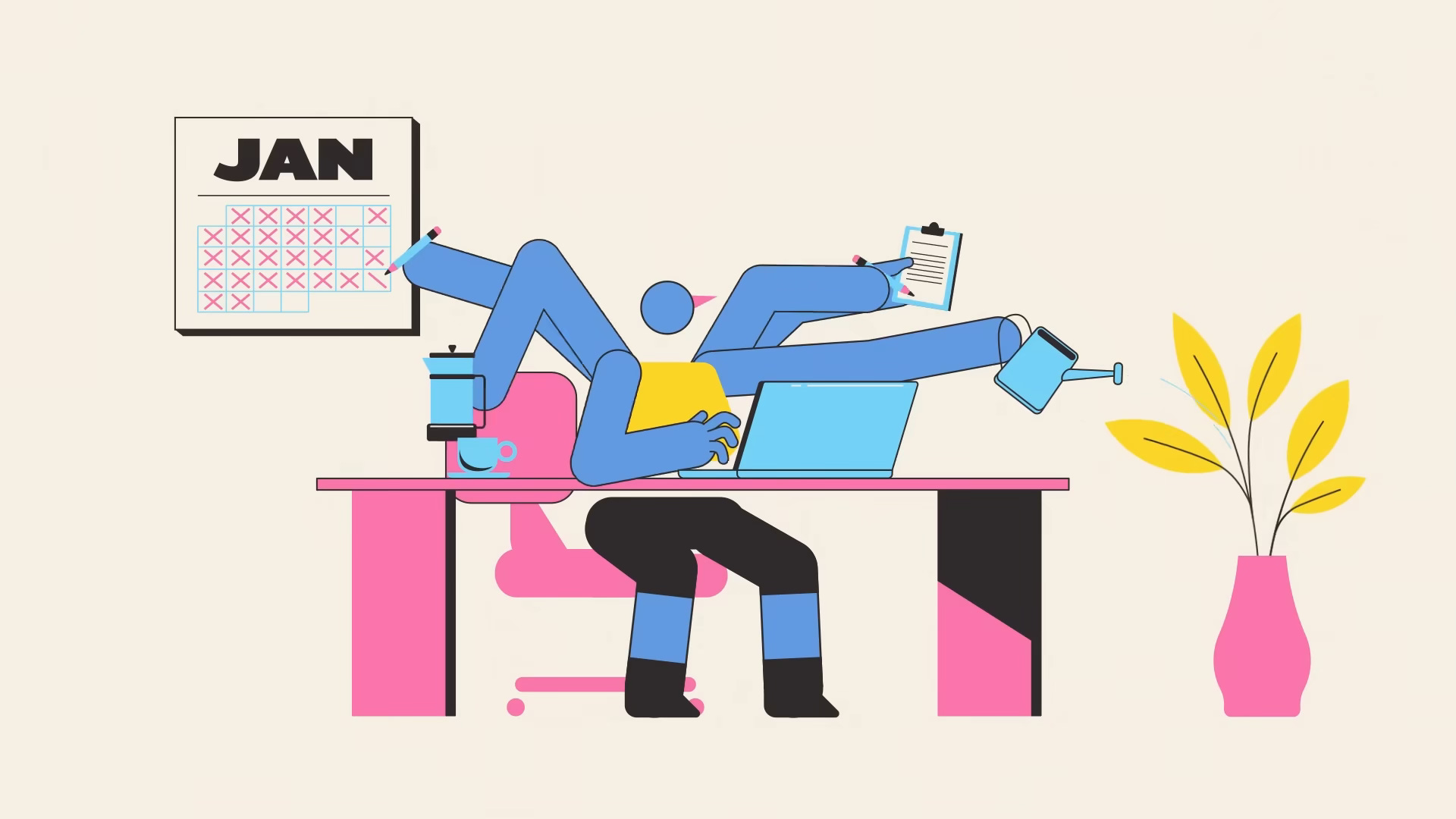
Cognitive scientist David Meyer was one of the first to quantify the “cognitive costs” of task switching. In a series of experiments, young adults alternated between exercises like solving maths problems and classifying geometric shapes. It turned out that they “lost time” whenever they switched. The time penalty could be as little as a few tenths of a second, but it increased in line with the task’s complexity.
When we try to operate in a near-constant state of task-switching, these costs quickly add up. Meyer concluded that, far from improving our productivity, multitasking can make things take up to twice as long.
The long-term effects may be even more troubling. Studies show that students who text during lectures learn less. Children who use instant messaging while learning to read show declines in their reading proficiency. A recent study found that one in three UK adults now struggles to read books because focusing on a single activity feels increasingly difficult.
Some research even suggests that heavy “media multitasking” – all that serial scrolling and double screening – correlates with structural differences in the brain, including reduced grey matter density in regions involved in attention control. While these findings do not prove causation, they raise uncomfortable questions about how our modern digital habits might impact our ability to concentrate over time.
When multitasking = danger
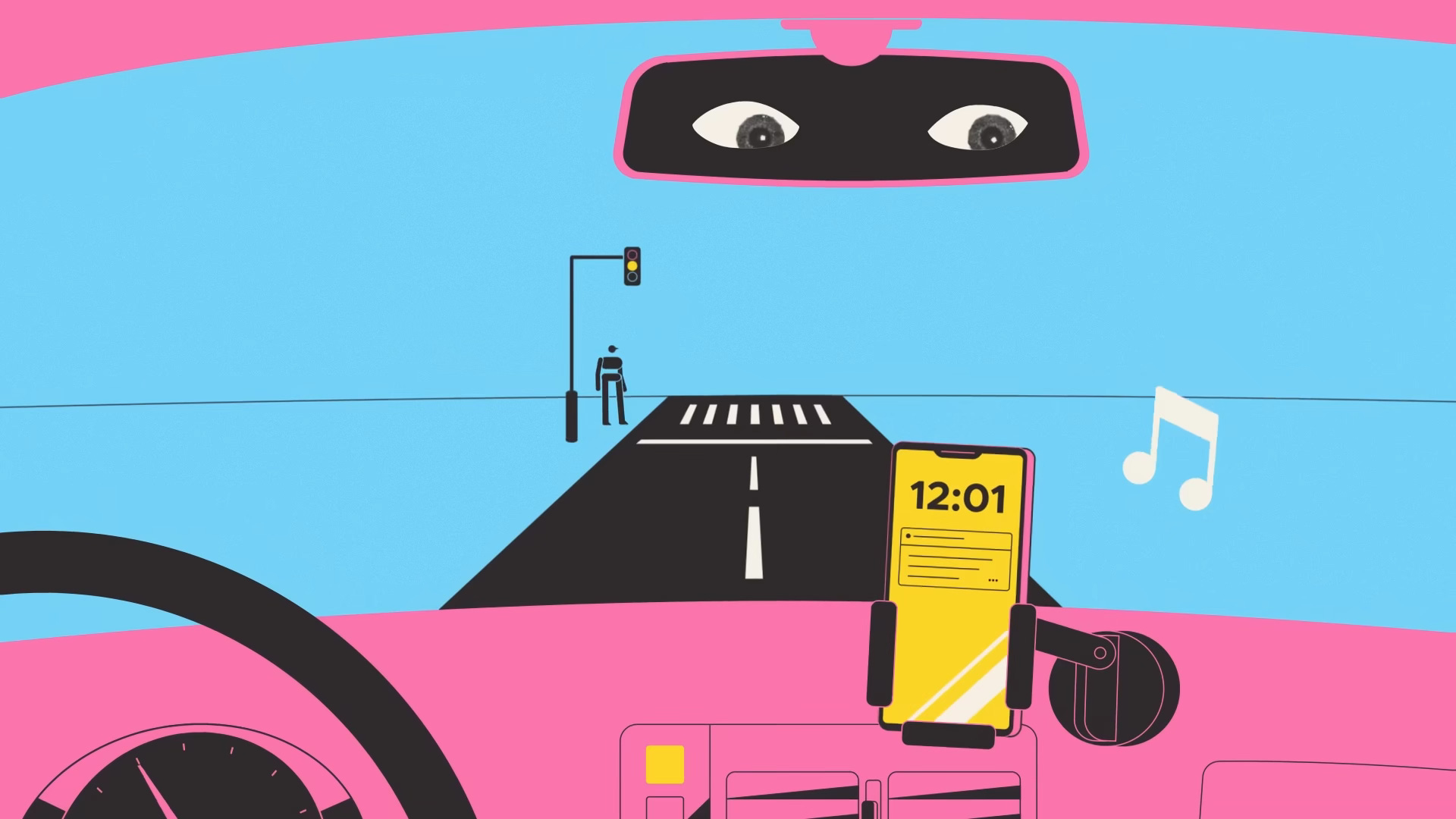
Overestimating our ability to multitask can sometimes have serious consequences. For instance, millions of people use their mobile phones while driving.
In one of the most famous studies on phone use at the wheel, cognitive neuroscientist David Strayer and colleagues at the University of Utah got volunteers to hold phone conversations while in a driving simulator. They then repeated the test, but this time they got the participants to drink enough alcohol to take them over the legal limit.
Strayer’s eye-opening finding? Driving on the phone is as dangerous as driving drunk. Crucially, this was true even when the phones were hands-free. You might have eyes on the road and both hands on the wheel – the issue is your mental bandwidth.
Two decades on from Strayer’s landmark study, many new cars are now equipped with voice assistants, touchscreens and dashboards that seamlessly integrate with our mobile phones. Given what science tells us about our capacity to pay attention to more than one thing, some fear this is a step backwards for road safety. Professor Robert Rosenberger, who has researched the subject extensively, warns:
“Just because your dashboard touchscreen or steering wheel has a button allowing you to make calls, doesn’t mean this is a safe practice.”
His advice: “Accept that you’re not as good at multitasking as you might think, and keep your focus where it belongs: on the road.”
Tips for monotasking
The logical alternative to multitasking is monotasking – deliberately focusing on one thing at a time.
That may sound simple, but it often requires more discipline and mental effort, particularly when we face near-constant demands for our attention.
Fortunately, productivity researchers have developed several evidence-based strategies that can help:
Task batching involves consolidating similar activities into focused blocks – for instance, keeping time for project work separate and only checking emails at designated times. This can also apply at larger scales: for example, setting aside a whole day, week or even month to focus on one project.1 Cal Newport, author of Deep Work, believes this unlocks a golden rule for using our time more productively:
Work Accomplished = Time Spent ✕ Intensity
Short, timed focus sprints, such as the Pomodoro Technique, encourage working for 25 uninterrupted minutes on a single task before taking a five-minute break. Studies suggest this structured approach can significantly improve productivity.
Reduce distractions. Use “focus” modes, silence notifications or – even better – put your phone in another room. After an interruption, it can take more than 20 minutes to fully regain concentration. Even the sight of a smartphone has been shown to impair cognitive performance.
Close your loops. Our brains are wired to keep reminding us of all the unfinished tasks we still need to do, a phenomenon psychologists call the Zeigarnik effect. A 2011 study found an effective way to stop this from hampering our focus. Simply writing down a clear next step helps to temporarily “close the loop” and free up mental space.
The multitasking exception: When two things can work better than one
Archimedes was splashing around in the bath when he had his “Eureka” moment. The ancient Greek inventor had been wrestling with what seemed an impossible problem: how to determine whether an ornate royal wreath was actually made of pure gold – without damaging it.
As he lowered himself into the tub, it occurred to him that there must be a relationship between the amount of bathwater that splashed out and the volume of his body. And there was his solution – by submerging the wreath in water, he could test whether it displaced the same volume as an equivalent mass of pure gold. This insight also solved the mystery of why some things float. We still refer to this today as Archimedes’ principle.
Now, inventing a method to spot fake gold and identifying one of the first universal laws of physics during a bath break could arguably be considered the ultimate advert for multitasking. But there’s a limit to how closely we can draw a parallel between bathroom-based multitasking in 287 BC and its modern-day equivalent. The one in seven people sending emails from the toilet can hardly claim to be emulating Archimedes.
His bathtime breakthrough is an example of what we might today call “strategic task switching”. Our conscious attention can only focus on one thing at a time. But when we’re trying to solve a difficult problem or think creatively, sometimes the best thing we can do is deliberately let our minds wander, and leave the conundrum ticking over in our subconscious.
Howard Gruber, one of the leading researchers on the psychology of creativity, found that switching between multiple projects was a defining feature of the most creative people. You could think of this as a form of very slow and deliberate multitasking.
But you don’t have to be pursuing world-changing breakthroughs to strategically pair activities.
Enjoying ambient music while doing admin, brainstorming while walking the dog or listening to an audiobook at the gym are all examples of where we can benefit from combining an “autopilot” activity with a more attention-hungry one. Research has even shown that a little doodling can help us stay alert and engaged when we don’t feel sufficiently stimulated by the task at hand.
So, yes – switching between tasks, or pairing certain activities, can sometimes be helpful. As long as we don’t fool ourselves into thinking we can actually focus on more than one of them.
Recommended links and further reading
Multi-tasking: How to Survive in the 21st Century (Tim Harford’s blog)
Go On, Admit It. You’re Multitasking. Here’s How to Do it Better (Psyche Ideas)
TikTok May Be Bad for Privacy, but Is It Also Harming Our Cognitive Abilities? (The Conversation)
Deep Work Helps You Produce at an Elite Level (HackerNoon Medium blog – excerpt from Deep Work by Cal Newport)
From One Second To The Next – a powerful short documentary by Werner Herzog on the dangers of texting while driving (YouTube)
Newport cites Adam Grant as a case study. Grant – a leading organisational psychologist, bestselling author, podcaster and top-rated Wharton professor – is famously prolific. His secret? Task batching on a massive scale. Across a year, Grant concentrates all his teaching in the autumn, so he can focus entirely on research in the spring. During term time, he alternates between periods when his door is open to students and week-long stretches when he switches on his out-of-office and isolates himself to focus on a single task. As Newport concludes: “My guess is that Adam Grant doesn’t work substantially more hours than the average professor at an elite research institution (generally speaking, this is a group prone to workaholism), but he still manages to produce more than just about anyone else in his field. I argue that his approach to batching helps explain this paradox.”